Most companies already have dashboards full of charts, yet managers still spend hours in meetings turning those charts into actions. Decision intelligence closes that gap. It is often described as BI plus AI plus decision science: the data foundation of BI, the prediction power of machine learning, and a structured way to choose the best action.
The shift is now mainstream. In January 2026, Gartner published its first Magic Quadrant for Decision Intelligence Platforms, a sign that the category has moved from idea to real market.
This guide provides clear definitions, a side-by-side comparison table, how AI powers decisions, the role of dashboards, what a decision intelligence platform includes, and a practical framework to choose between BI, DI, or both.
What Is Business Intelligence (BI)?
Business intelligence collects, analyzes, and visualizes historical and current data to help people make better decisions.
BI pulls data from systems such as ERP, CRM, and point-of-sale, cleans it, and presents it in reports and business intelligence dashboards. It answers questions like "How did sales perform last quarter?" and "Which region is falling behind?" The decision itself stays with a human, who reads the chart and decides what it means.
A Complete Guide For Business Intelligence
What Is Decision Intelligence (DI)?
Decision intelligence is a discipline that combines business intelligence, machine learning, and decision science to model, predict, and often automate decisions, not just inform them.
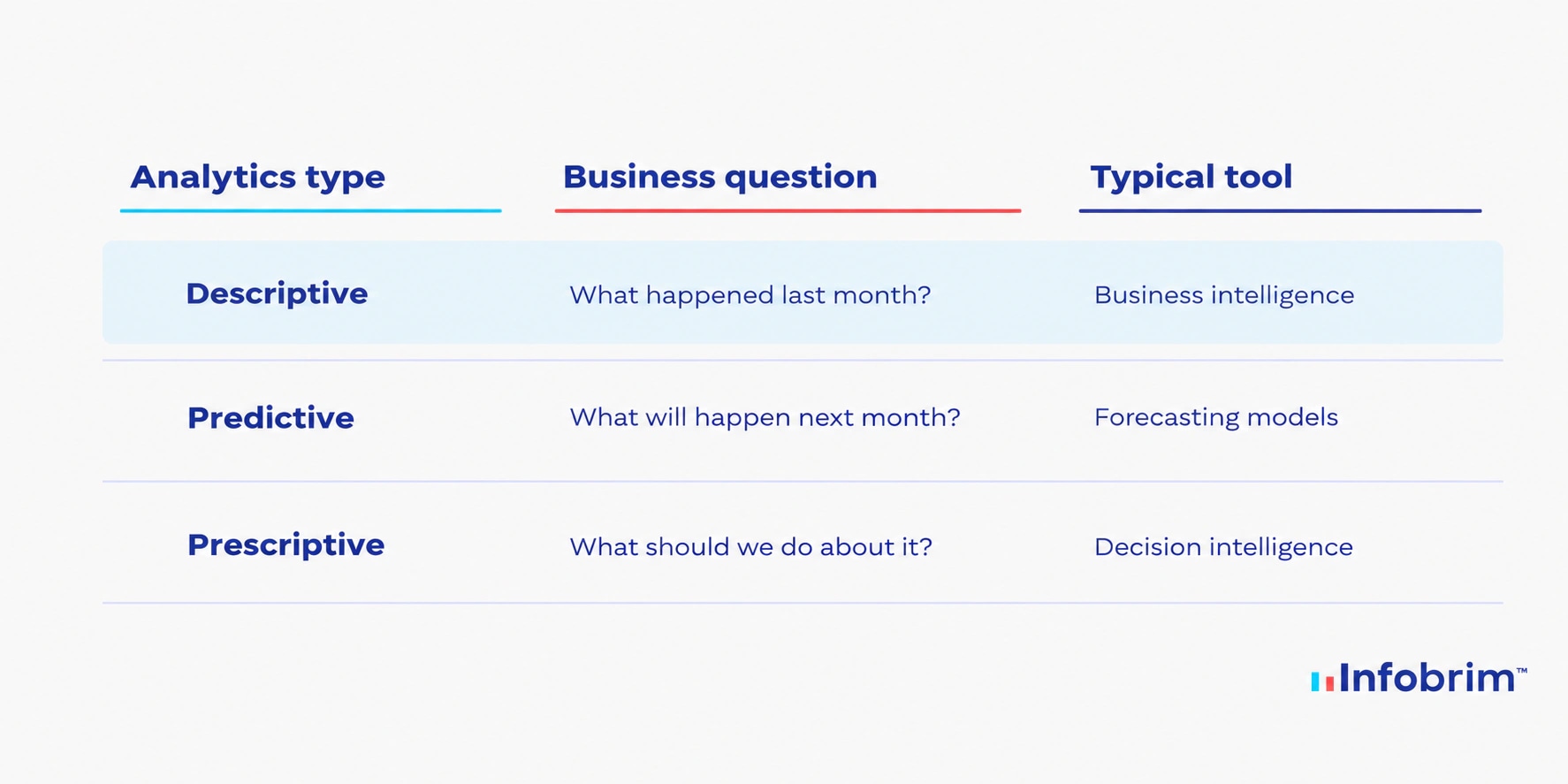
Where BI stops at insight, decision intelligence continues to action. It completes the analytics maturity ladder:
Descriptive: What happened?
Predictive: What is likely to happen?
Prescriptive: What should we do about it?
A decision intelligence system might predict a stock shortage next week, compare three ways to handle it, recommend the cheapest one, and, if approved, place the order automatically.
Decision Intelligence vs. Business Intelligence: A Direct Comparison
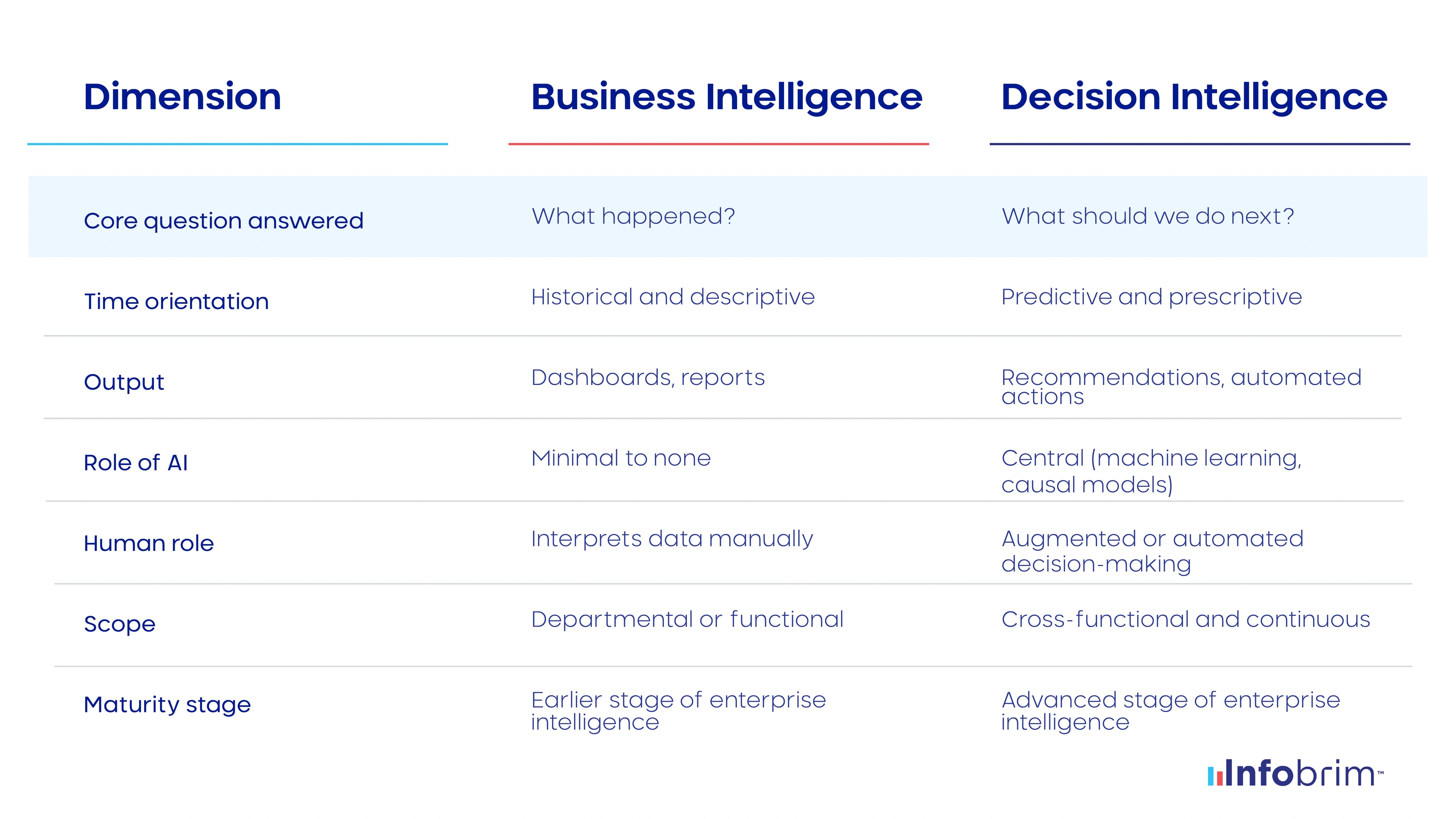
Decision intelligence depends on the clean, connected data that BI provides. Without a strong BI foundation, DI has nothing reliable to reason with. Think of BI as the eyes of the business and DI as the brain that decides where to move next.
See both layers working together. Infobrim brings your data foundation and decision support into one platform. Explore the Infobrim platform
How Artificial Intelligence Powers Decision Making
Artificial intelligence decision-making follows four clear steps that turn raw data into action:
Pattern recognition: Models scan large datasets and spot trends people would miss.
Prediction: They estimate what is likely to happen, such as demand, churn, or risk.
Recommendation: They compare options and suggest the best next move.
Automated action (optional): For routine, approved decisions, the system acts on its own.
There is an important difference between two kinds of models:
Correlation-based machine learning finds what usually happens together.
Causal models go further and explain why something happens and what will change if you act.
That "why" is what lets decision intelligence recommend an action with confidence, instead of only flagging a likely outcome.
The link between artificial intelligence and decision-making is already part of daily business. McKinsey's 2025 State of AI survey found that 88% of organizations now use AI regularly in at least one business function, up from 78% a year earlier.
Where Business Intelligence Ends and Decision Intelligence Begins
The line between decision intelligence and business intelligence becomes clear when you follow the path from data to business outcomes. BI covers the analytical stages that help a company understand and anticipate what is happening. DI then takes the most important insights and carries them through a clear, accountable decision and into execution.
Business Intelligence Turns Data into Insight
BI organizes and analyzes performance, trends, relationships, and exceptions. A business intelligence dashboard might reveal a shift in demand, a cost overrun, an operating anomaly, or a change in customer behavior.
At this stage, the goal is understanding: what is driving performance, and which signals deserve a closer look.
Modern BI Extends Insight Forward
BI no longer stops at last month's report. Real-time data shows how conditions are changing right now, forecasting models estimate what is likely to happen next, and prescriptive features suggest possible responses based on the available data and agreed criteria.
Here, teams use BI to track change, assess likely outcomes, and spot where a response may be needed.
Decision Intelligence Connects Insight to Action
Once BI surfaces a signal that needs a response, decision intelligence organizes what happens next:
Define the decision: Which decision does this signal affect, and who owns it?
Add business context: Bring in objectives, rules, constraints, and trade-offs.
Choose the action: Compare the options and select the most appropriate response.
Execute: Link the decision to the workflow that carries it out.
Learn: Feed the outcome back in, so every result strengthens the next decision.
With Infobrim, teams move through these steps faster. They can ask what changed in plain Arabic or English, test what-if scenarios before committing, and see the reasoning behind every forecast, all from one live source of truth.
Request a free demo and discover how to turn your business data into smarter decisions and faster action.
When Should You Use Business Intelligence, Decision Intelligence, or Both?
The right choice depends on your priority: understanding business conditions, improving how specific decisions are made, or connecting both across the whole decision process.
Use Business Intelligence When...
Company-wide visibility is the main need.
Leaders need standardized reports and KPIs.
Teams need exploratory or ad hoc analysis.
Performance monitoring is the main goal.
These cases depend on trusted data and easy-to-use analytics that give everyone the same view of business performance, which you can also find in Infobrim.
Add Decision Intelligence When...
Insights take too long to turn into action.
Decisions cross teams with different priorities or signals.
Slow decisions create a measurable cost, risk, or operational impact.
Recurring decisions would benefit from consistent rules and context.
Leaders need to know whether decisions deliver the intended results.
These signs point to a need for more structure around how decisions are made, owned, and carried through to execution.
Use Both for End-to-End Decision-Making
For many enterprises, the strongest model combines both. BI gives teams a shared view of business conditions, while DI adds structure to the high-value decisions that follow.
This works especially well for recurring, cross-functional decisions shaped by multiple signals, competing priorities, or operational dependencies. Together, BI and DI move an organization from a common view of performance to consistent, coordinated action.
How to Build Decision Intelligence on Your Existing Data Foundation
Connect, don't migrate: Link your existing sources so every decision draws on the same live data.
Pick one decision: Choose a frequent, costly decision, such as weekly reordering or discount approvals, and record how long it takes and what mistakes cost today.
Add context: Document the objectives, rules, constraints, and decision owners.
Pilot and measure: Run DI on that single decision for 60 to 90 days and compare the results with your baseline.
Scale: Extend the approach to the next decision once it proves its value.
The Infobrim Federation Engine makes the first step simple. It connects across on-prem, cloud, or hybrid systems with no ETL and no migration, with data governance, sovereignty, and compliance built in.
Not sure where to start? See how retail, F&B, logistics, finance, healthcare, and manufacturing teams use Infobrim to make faster decisions. Browse solutions by industry
Analytics for Business Decision Making: Where BI, Predictive Analytics, and DI Fit
Analytics for business decision making is the umbrella that covers all three approaches. Each one answers a different business question:
What Is a Decision Intelligence Platform?
A decision intelligence platform is software that combines data integration, predictive and causal models, simulation, and recommendation or automation engines to help organizations design, run, and improve their decisions.
A complete decision intelligence platform includes five core components:
Data integration layer: Connects ERP, CRM, finance, HR, and operational systems so every decision uses the same trusted data.
Predictive and machine learning models: Forecast demand, risk, churn, and other outcomes.
Decision modeling and simulation: Tests "what if" scenarios before you commit, such as the effect of a 5% price change.
Recommendation or automation engine: Suggests the best action or executes approved actions automatically.
Feedback loop and outcome tracking: Measures what happened after each decision, so the system learns and improves.
This is exactly the gap Infobrim fills. It connects across on-prem, cloud, or hybrid systems with no ETL and no migration, lets teams ask questions in plain Arabic or English, and returns real-time analysis, forecasts, and what-if scenarios with the reasoning behind them, all with data governance, sovereignty, and compliance built in.
Connect every system without moving a single record. Learn how the Federation Engine works, and see how your data stays protected with Infobrim Security & Privacy.
Your business has the data. But does it have the right decisions? Request a free demo and discover how Infobrim turns business intelligence into smarter decisions and measurable results.