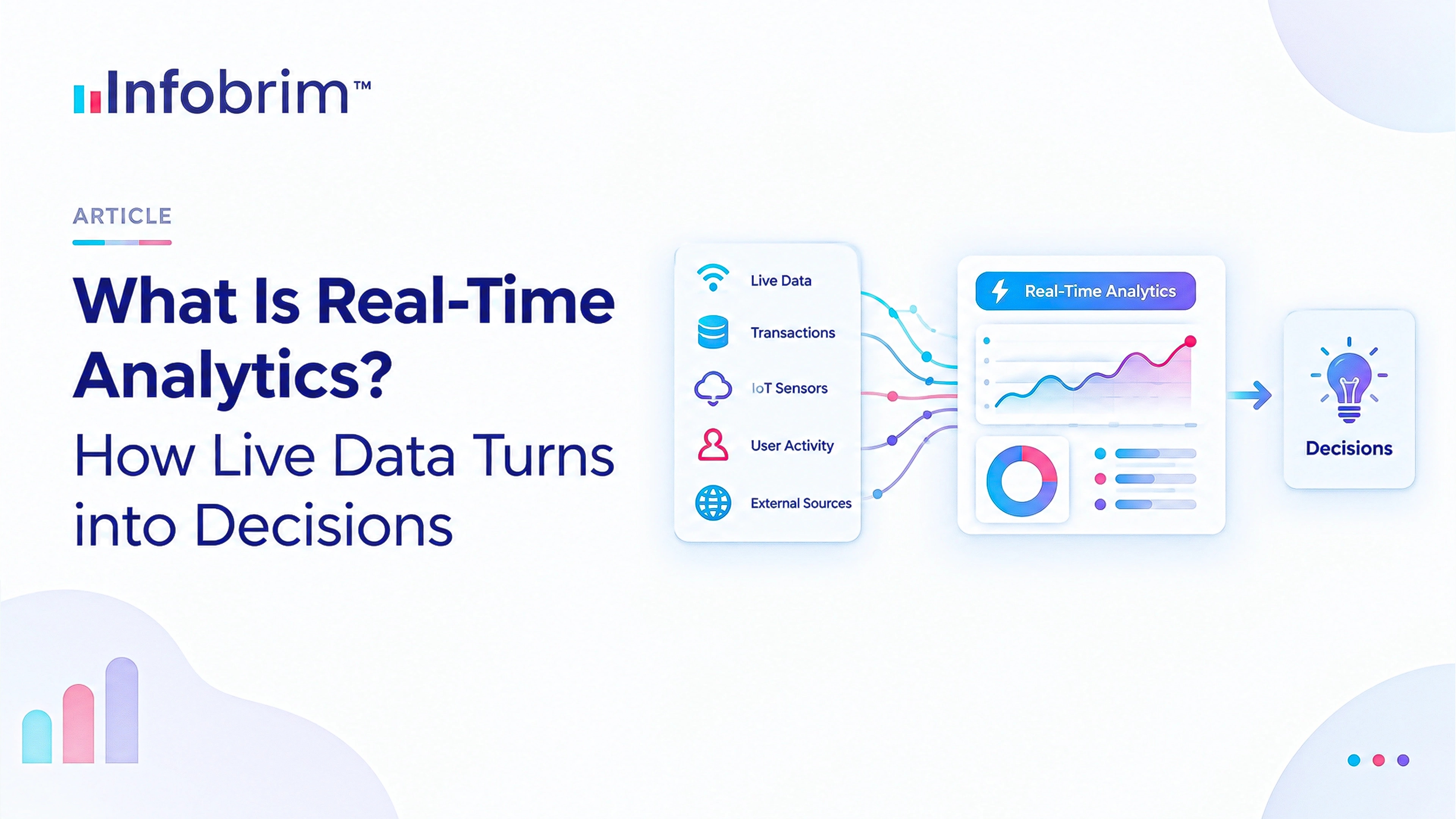
Real-time analytics is the practice of collecting, processing, and analyzing data as it is created, so insights are ready while the moment still matters. In short, it turns live data into decisions made in minutes instead of days.
But speed on its own is not the point. Real-time analytics matters because it shortens the gap between something happening in your business and someone deciding what to do about it. A dashboard that refreshes quickly is only useful if the data underneath is current and someone is ready to act on it.
This guide explains how real-time analytics works, what "real-time" actually requires from data to decision, how it differs from traditional analytics, the types of insights it delivers, its benefits, real-world use cases, what a real-time analytics platform should include, and what to check before you invest.
If you are new to the wider topic, start with how business intelligence works more broadly.
What Is Real-Time Analytics?
Real-time analytics is the practice of collecting, processing, and analyzing data continuously, with minimal delay, so that insights are available while the underlying event is still operationally relevant.
Gartner describes real-time analytics as applying logic and mathematics to data to support better decisions quickly, and notes that for many use cases "real time" simply means the analysis finishes within seconds or minutes of new data arriving. It also separates two modes:
On-demand real-time analytics: The system waits for a person or another system to ask a question, then returns the answer fast.
Continuous real-time analytics: The system works proactively, alerting people or triggering a response as events happen.
Benefits of Real-Time Analytics
Each benefit below follows the same logic: a specific mechanism that leads to a business outcome.
Faster, more confident decisions: The information behind each decision reflects current conditions, not a stale snapshot, so leaders spend less time second-guessing the numbers.
Reduced operational risk: Fraud, equipment failure signals, and quality issues can be caught while there is still time to intervene.
Better customer experience: Offers and service responses reflect what a customer is doing now, not what they did last week.
Smarter resource allocation: Inventory, staffing, and logistics respond to actual demand rather than a forecast built on lagging data.
Competitive responsiveness: Teams can react to a market or operational shift while it is still unfolding, not after a competitor has already moved.
Better forecasting inputs: Predictive models fed with current data tend to reflect present conditions more accurately than models updated only occasionally.
How Does Real-Time Analytics Work?
Real-time analytics moves data through six steps, from the moment an event happens to the moment someone acts on it.
1. Data Collection
Data is captured continuously from operational sources: sales transactions, sensors, application logs, websites, and customer activity. The goal is to record each event as close as possible to when it happens.
2. Data Ingestion
Instead of loading data on a fixed schedule, such as once a night, real-time ingestion streams events in as they occur or pulls them at very short intervals. This is the first place where delay can creep in, so the ingestion method sets an upper limit on how "real-time" everything after it can be.
3. Processing and Transformation
Incoming data is cleaned, enriched, and structured on the fly. Duplicates are removed, formats are standardized, and records are linked to useful context, such as matching a transaction to its branch and product category.
4. Data Integration: Two Architectural Paths
This is the step most guides skip, yet it shapes cost, freshness, and governance more than any other. There are two main ways to bring data together for analysis:
Replicate, then analyze: Data is copied out of source systems into a central data warehouse or data lake, and analysis runs on the copy. This approach is mature and well understood. However, the copy always lags behind the source, and teams must build and maintain the pipelines that keep it up to date.
Federate at query time: Analytics tools query the source systems directly, or through a live access layer, without copying the data first. This removes the replication lag and the pipeline maintenance, but it puts more demand on the query layer and on the performance of the source systems themselves.
Neither approach is better in every case. The right choice depends on your data volume, how much spare capacity your source systems have, your governance requirements, and how fresh "real-time" really needs to be for each use case. To see how a query-in-place architecture works in practice, explore the Infobrim Federation Engine.
5. Analysis
With current data in place, analysis can run at four levels: descriptive (what is happening), diagnostic (why), predictive (what is likely next), and prescriptive (what to do). These levels are explained in the "types of insights" section below.
6. Action
Finally, the insight reaches a decision-maker through a live dashboard, an alert, or a direct answer to a question, or it triggers an automated action, such as pausing a suspicious payment. This is where real-time analytics either creates business value or stops short of it.
Real-Time Analytics vs. Traditional Analytics
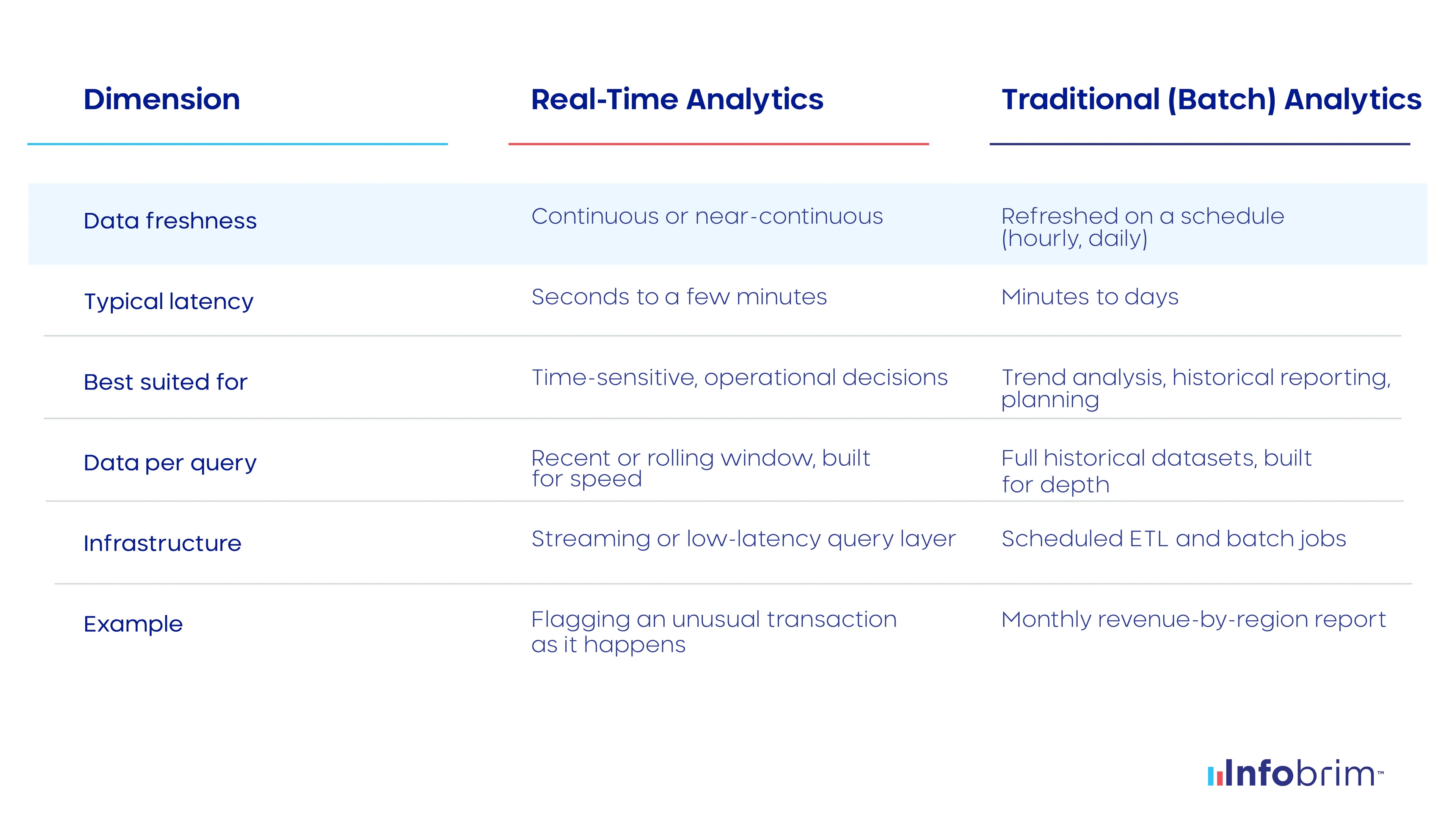
The difference between real-time and traditional analytics comes down to how fresh the data is and what kind of decision it supports.
Types of Insights Real-Time Analytics Can Deliver
There are four types of insights, and each one looks different when the data is live:
Descriptive Insights: What Is Happening Right Now
Current transaction volume, live branch traffic, or orders placed in the last ten minutes.
Diagnostic Insights: Why It Is Happening
Tracing a sudden sales dip in one region to a stalled delivery, a payment outage, or an empty shelf.
Predictive Insights: What Is Likely to Happen Next
Flagging a probable stock-out within hours, based on how fast an item is selling right now.
Prescriptive Insights: What Action to Take
An automatic reorder trigger, or a recommended staffing change for the evening shift. This is also where real-time analytics connects with decision intelligence, the discipline of turning predictive and prescriptive insight into structured decisions.
Learn more about deference between Business Intelligence & Decision Intelligence 🡭
Real-World Use Cases of Real-Time Analytics
Real-time analytics improves operational efficiency across departments and industries. It helps teams fine-tune processes, cut downtime, and act on insights the moment they appear, drawing on data from sensors, mobile apps, financial systems, and customer interactions. Here is how different teams put it to work.
1. Operations, Manufacturing, and Supply Chain
Operations and manufacturing teams use real-time analytics to fine-tune production, support predictive maintenance, spot bottlenecks, and respond quickly to disruptions. By watching equipment performance and supply chain activity live, they reduce downtime and make better use of people, machines, and materials.
2. Marketing, Sales, and Customer Experience
Marketing and sales teams use live data to personalize customer experiences, adjust pricing, catch new opportunities early, and track campaign performance as it happens. Combining live customer interactions with historical data lets them tailor offers, smooth out digital journeys, and adjust campaigns across channels in the moment.
3. Customer Service and Support
Customer-facing teams use real-time analytics to anticipate needs, resolve issues faster, and offer help before a customer asks. A smart service assistant, for example, can read live interactions, transaction data, and customer sentiment, then suggest the best response or next step to the agent in real time. The result is higher customer satisfaction.
4. Transportation and Logistics
Live data from GPS devices, vehicles, drivers, and customers lets logistics companies reroute deliveries on the fly, improve delivery accuracy, cut fuel use, and give customers up-to-date tracking. Dispatchers can also balance demand against available capacity, which means faster deliveries and a more efficient network.
5. Healthcare Providers
In healthcare, real-time analytics helps providers monitor patient vital signs, catch early signs of deterioration, and respond to emergencies quickly. It also supports predictive models that help tailor treatment and improve patient outcomes.
6. Financial Institutions
Banks and insurers use real-time analytics to sharpen forecasts, manage risk, and add value for customers. It also powers fraud detection: models scan high-volume transaction streams as they flow, flag suspicious patterns, and stop losses before money leaves the account.
7. Cybersecurity
Security teams rely on real-time analytics to monitor network activity, detect threats, and respond to incidents as they happen. By analyzing logs, user behavior, and system events live, organizations contain attacks faster and strengthen their overall security.
8. Sports and Fan Engagement
Sports organizations use real-time analytics to enrich the fan experience. Live player statistics, in-match predictions, and personalized highlight reels keep fans engaged and informed throughout the game, and give clubs and broadcasters new ways to tailor content to each viewer.
Real-Time Analytics Platforms
A real-time analytics platform is software that ingests, processes, analyzes, and presents insight from continuously updating data. This sets it apart from a general data analytics platform or BI tool that mainly works on scheduled refreshes.
Use this checklist when you evaluate any real-time analytics platform:
Low-latency ingestion: Streaming or near-real-time connectors to your sources.
A clear integration model: A direct answer to the replicate-or-federate question, and what that trade-off means for your organization.
A fast query engine: Sub-minute responses at your actual data volume, not just in a demo.
Live visualization: Charts that refresh from live data, not static exports.
Governance at the data layer: Access control and audit trails enforced at the source, not only inside the dashboard.
Fit with your systems: The ability to connect to what you already run, not just a fixed connector list.
The Best Real-Time Analytics Platform
Infobrim was built to tick every box above:
Live connections: It links directly to your ERP, POS, CRM, HR, and finance systems, so insights reflect what is happening now.
A clear integration model: It federates at query time, with no ETL and no migration, so there is no copy to fall behind.
Fast answers: Ask in plain Arabic or English and get real-time analysis, forecasts, and what-if scenarios, with the reasoning behind them.
Live visualization: Dashboards stay connected to live data, so every filter and drill-down shows current numbers.
Governance built in: Data governance, sovereignty, and compliance are enforced from the ground up.
Fits your systems: It works across on-prem, cloud, or hybrid environments, without replacing what you already run.
Request a free demo to see it on your own data.
Infobrim is built around this checklist. It answers the integration question with federation: it connects across on-prem, cloud, or hybrid systems, including ERP, POS, CRM, HR, and finance, with no ETL and no migration.
Teams get real-time analysis, forecasts, and what-if scenarios on live dashboards, with data governance, sovereignty, and compliance built in at the data layer rather than added on top.
Enterprise Considerations Before Adopting Real-Time Analytics
The moment "real-time" means live access to operational systems, governance becomes a first-order question. Check these five areas before you invest:
Data governance and access control: Who can see what, down to the row or column? Can those rules be enforced consistently across every connected source, not just inside the analytics tool?
Auditability: Can every query and every data access be traced? This matters for regulatory compliance and for internal trust in the numbers.
Source-system performance: Will real-time or near-real-time queries add load to your operational systems, in either a replication or a federation model, and are those systems sized for it?
Data quality at speed: Real-time does not remove the need for clean data. Errors now reach decision-makers faster, so validation matters more, not less.
Organizational readiness: Real-time analytics creates value only if a person or an automated process is ready to act quickly. Faster data without faster decisions limits the return.
For an example of governance enforced at the data layer, see how Infobrim Security and Privacy handles access control and audit trails.
When Does a Business Actually Need Real-Time Analytics?
Real-time analytics delivers the most value when decisions are time-sensitive, frequent, and costly to delay: fraud, stock-outs, equipment failures, and customer-facing service issues are classic examples.
It adds much less for decisions that are slow-moving or infrequent, such as annual budgeting or long-term strategic planning. For those, traditional analytics remains entirely appropriate. A simple test: if a decision made one day later would cost you nothing, it probably does not need real-time data.