Your enterprise already holds the data it needs. It sits in SAP or Oracle ERPs, the CRM, point-of-sale terminals, and branch systems. Yet every new question still waits for someone to build, test, and maintain a pipeline. By the time the report ships, the numbers are old, two departments quote different figures, and one more copy of sensitive data needs securing. No-ETL data federation reverses that order: the question goes to the data. This guide explains what it means, how it differs from zero-ETL, and where it fits.
What Is No-ETL Data Federation?
No-ETL data federation is a data access approach that queries information directly in its source systems when a question is asked, instead of extracting, transforming and loading copies into a central warehouse first.
Traditional ETL copies, reshapes and loads data on a schedule. Federation leaves the data where it is and sends the query to it.
Is No-ETL the Same as Zero-ETL?
In everyday use, the two terms overlap. Zero-ETL, popularized by AWS at re:Invent in 2022, is the wider umbrella. No-ETL data federation is the narrower form that keeps data in its source systems.
How Do Federation, Virtualization and Replication Differ?
Data virtualization creates one logical view over many sources without moving them.
Data federation runs a single query across those sources and combines the results. IBM describes federation as a core technology within data virtualization.
Replication copies data from one system to another, on a schedule or through change data capture (CDC).
What Does "Zero-ETL" Actually Mean When Vendors Say It?
Those definitions matter because the market now uses one label for three different mechanisms. Ask which one a platform means:
Copy it. The platform replicates your source into its own store in near real time. You build no pipeline, but you still own a new copy.
Reshape it later. Data is loaded in its original shape and the transformation step before analysis is skipped. Less engineering, but the data still moves.
Query it in place. The question travels to the data, and the answer comes back without a new dataset being created.
Only the third pattern avoids creating a new copy, and that is what no-ETL data federation means.
Why Does the ETL Pipeline Slow Down Business Decisions?
A pipeline is an automated path that moves data, step by step, from the systems where it lives to the place where it is analyzed.
Once the terms are clear, the cost of each approach becomes clear too. Every new source or report needs its own cycle of building, testing and maintenance, and by the time it goes live, its data is already out of date.
This problem is common. 81% of IT leaders say data silos hold back digital transformation (MuleSoft/Salesforce Connectivity Benchmark Report, 2024). And 67% of highly centralized enterprises spend more than 80% of their data-engineering resources just keeping pipelines running (Fivetran, May 2025).
What a data leader notices most is the waiting: a week to understand why a number moved, or a board meeting where sales and finance report different revenue. Closing that gap is the first step from reporting toward decision intelligence.
How Does No-ETL Data Federation Work?
The mechanism is simpler than the pipeline it replaces:
Connect ERP, CRM, databases and files without moving data.
Define shared metrics such as revenue or margin once, in a semantic layer.
Ask a question through a dashboard or in natural language, in Arabic or English.
Run the work in the sources, so teams query data in place.
Return one governed answer, filtered by role-based and row-level access.
This is what practitioners mean by zero-copy data integration. Infobrim follows this approach and pairs it with a governed semantic layer, so live answers stay consistent.
How Does ETL Compare With Data Federation?
Side by side:
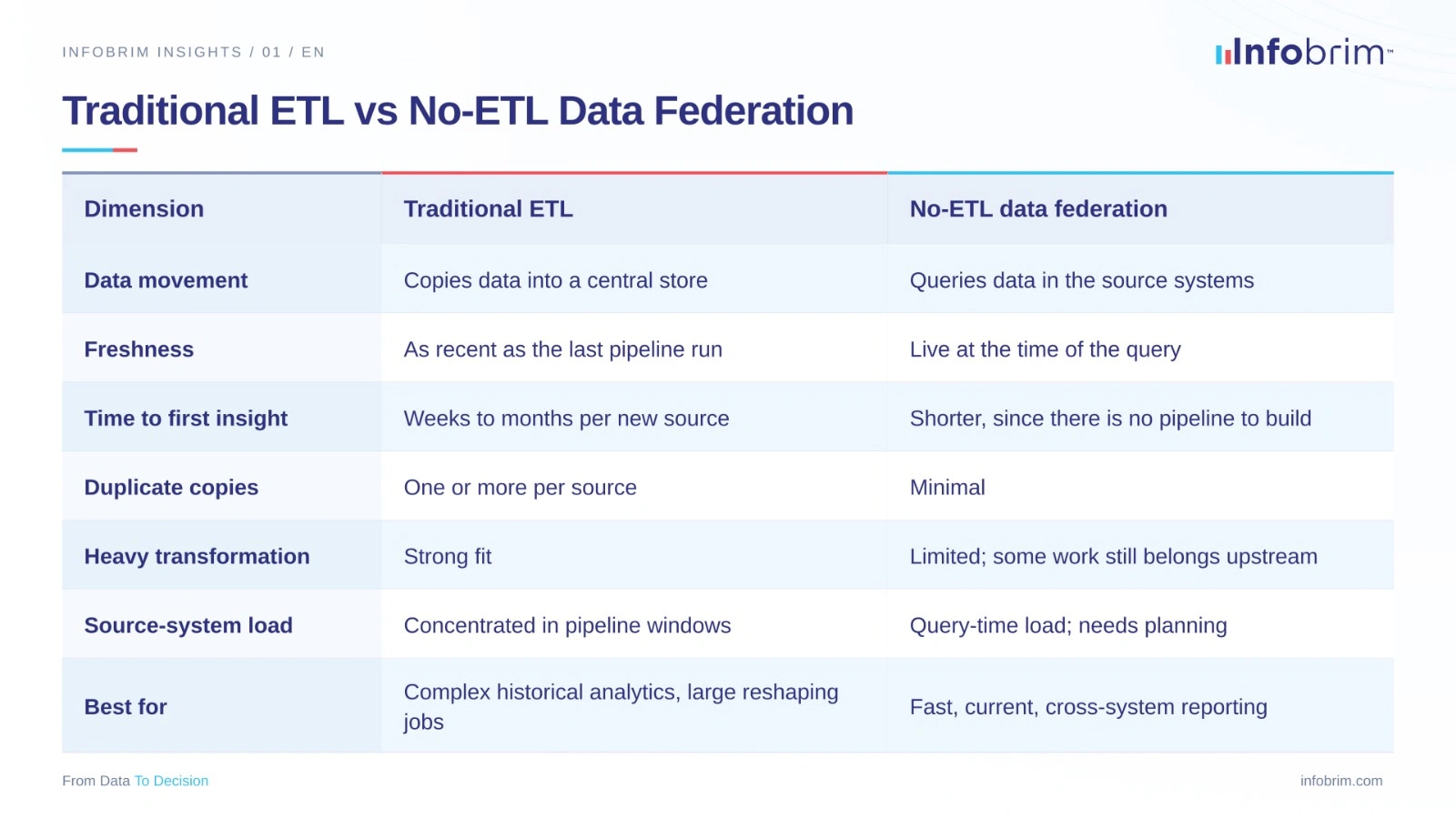
ETL still wins where data must be heavily reshaped or analyzed across many years of history. Federation wins where the question is current and spans several systems.
Why Are Enterprises Moving to No-ETL Data Federation?
The reasons leaders give are practical.
How Does It Shorten Time to Insight?
Adding a source becomes a connection, not a project. Real-time data federation, meaning near-real-time for supported workloads, turns live data into data insights and data visualizations faster. See our guide to real-time analytics.
How Do Fewer Copies Reduce Risk and Cost?
Every extra copy of data is another place to secure, classify and audit. Fewer copies also mean less storage and fewer reconciliation disputes.
Why Is It a Better Foundation for AI and Natural-Language Analytics?
41% of organizations say a lack of real-time data access stops AI models from delivering timely insights (Fivetran, May 2025). AI answering over live, governed data gives business users answers they can defend.
What Changes for Saudi Enterprises?
A typical Saudi organization runs SAP or Oracle at head office, separate systems in branches, and data that must stay in the Kingdom or on-premises. Many zero-ETL features are cloud-first, so no-ETL data federation that also works on-premises and in hybrid setups fits this reality better.
Fewer copies also make existing obligations easier to manage, including the Personal Data Protection Law (PDPL), National Data Management Office (NDMO) requirements and the National Cybersecurity Authority Essential Cybersecurity Controls (NCA ECC). Confirm your specific obligations with your compliance or legal team.
Illustrative scenario: a retailer with dozens of branches sees yesterday's sales by region each morning, without a nightly sync job.
What Doesn't No-ETL Data Federation Solve?
Knowing how it works shows where it stops. Data modeling, quality, and governance still matter; federation changes how data arrives, not the need for a governed foundation. Query performance depends on the implementation. Heavy analytical queries need planning so they do not slow operational systems, and source outages or schema changes affect results.
Federate for fresh, cross-system questions, copy for heavy historical reshaping, and combine both in most enterprises.
How Should You Evaluate a No-ETL Data Federation Platform?
Test six points in a proof of concept:
Connectors for the systems you actually run.
Query performance on your real data volumes.
Governance: role-based and row-level access, audit, and a shared semantic layer.
Deployment and residency options that match your policies.
Arabic and English support for business users.
Time to the first governed answer on one real source.
What Should Saudi Data Leaders Do Next?
Ask every vendor which of the three zero-ETL patterns they mean.
Federate current, cross-system questions; keep ETL for heavy historical work.
Fix shared metric definitions before you scale business analytics and data analytics across teams.
Read why 2027 belongs to data platforms for the wider shift behind this change.
To see the approach on your own systems, explore how Infobrim delivers analytics without data migration.
Request a free demo and see your data work as one.