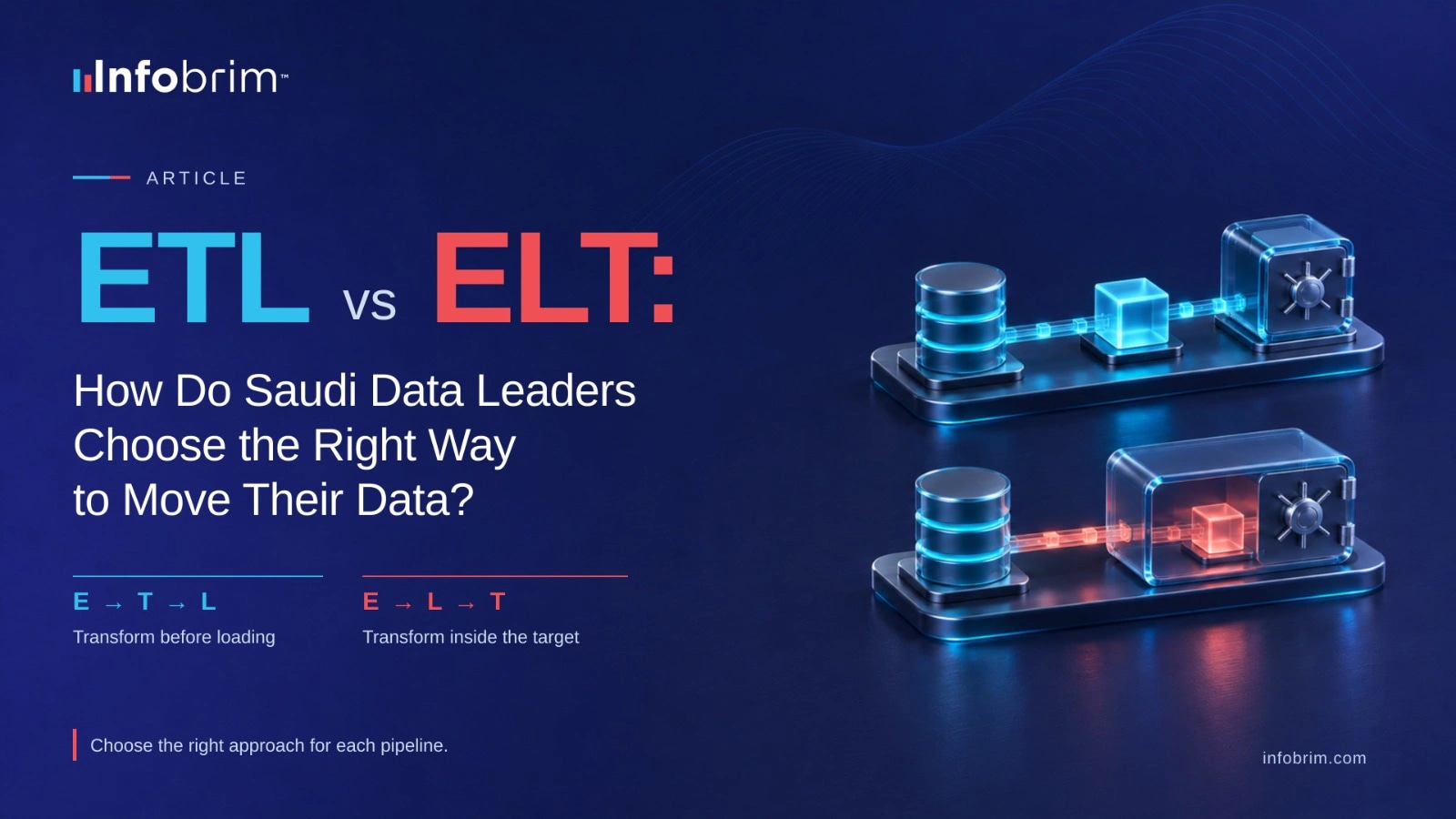
Your data lives in an ERP, a CRM, and branch systems, and it has to come together before anyone can analyze it. That raises a question that sounds technical but shapes your budget, your timelines, and your risk: do you clean the data before you move it, or move it first and clean it later?
Get it wrong, and you may face a processing bill that keeps growing, or sensitive records landing where they should never be stored.
This guide explains ETL vs ELT in plain terms, when each one fits, and how to decide with six practical questions.
What Is the Difference Between ETL vs ELT?
The main difference between ETL and ELT is the order of the steps: ETL transforms data before loading it into the target system, while ELT loads raw data first and transforms it inside the target.
Both use the same three steps. What changes is when and where transformation runs, which is how both Google Cloud and IBM frame the difference between ETL and ELT.
What Is ETL?
ETL (extract, transform, load) pulls data from source systems, reshapes it in a separate engine, then loads the result into a data warehouse.
What Is ELT?
ELT (extract, load, transform) moves raw data into a cloud warehouse or data lake and transforms it there when needed.
Why Did ELT Appear Decades After ETL?
Data engineers have been building ETL processes since the 1970s, according to IBM. Back then, warehouses ran on expensive on-premises hardware with limited, tightly coupled storage and processing power, so cleaning and shrinking data before it entered was simply good economics.
Cloud platforms changed the equation by separating storage from compute. As Joe Reis and Matt Housley explain in Fundamentals of Data Engineering, storage became cheap and nearly limitless, and compute became available on demand. Loading raw data first became practical, and ELT followed.
How Does Each One Handle the Shape of Data?
The deepest difference in the ETL vs ELT comparison is when the schema, meaning the structure of tables and the types of their columns, gets enforced. Martin Kleppmann describes both models in Designing Data-Intensive Applications:
Schema-on-write (ETL): the table structure is defined in advance, and only data that fits it gets in. Tables stay clean and reliable, but a source change, such as a new column, can stop the pipeline.
Schema-on-read (ELT): data is stored as it arrives, and its structure is interpreted when you query it. You gain flexibility, and take on more governance work so stored data does not become a mess.
What Are the Key Differences Between ETL vs ELT?
This table sets out the ETL vs ELT pros and cons side by side:
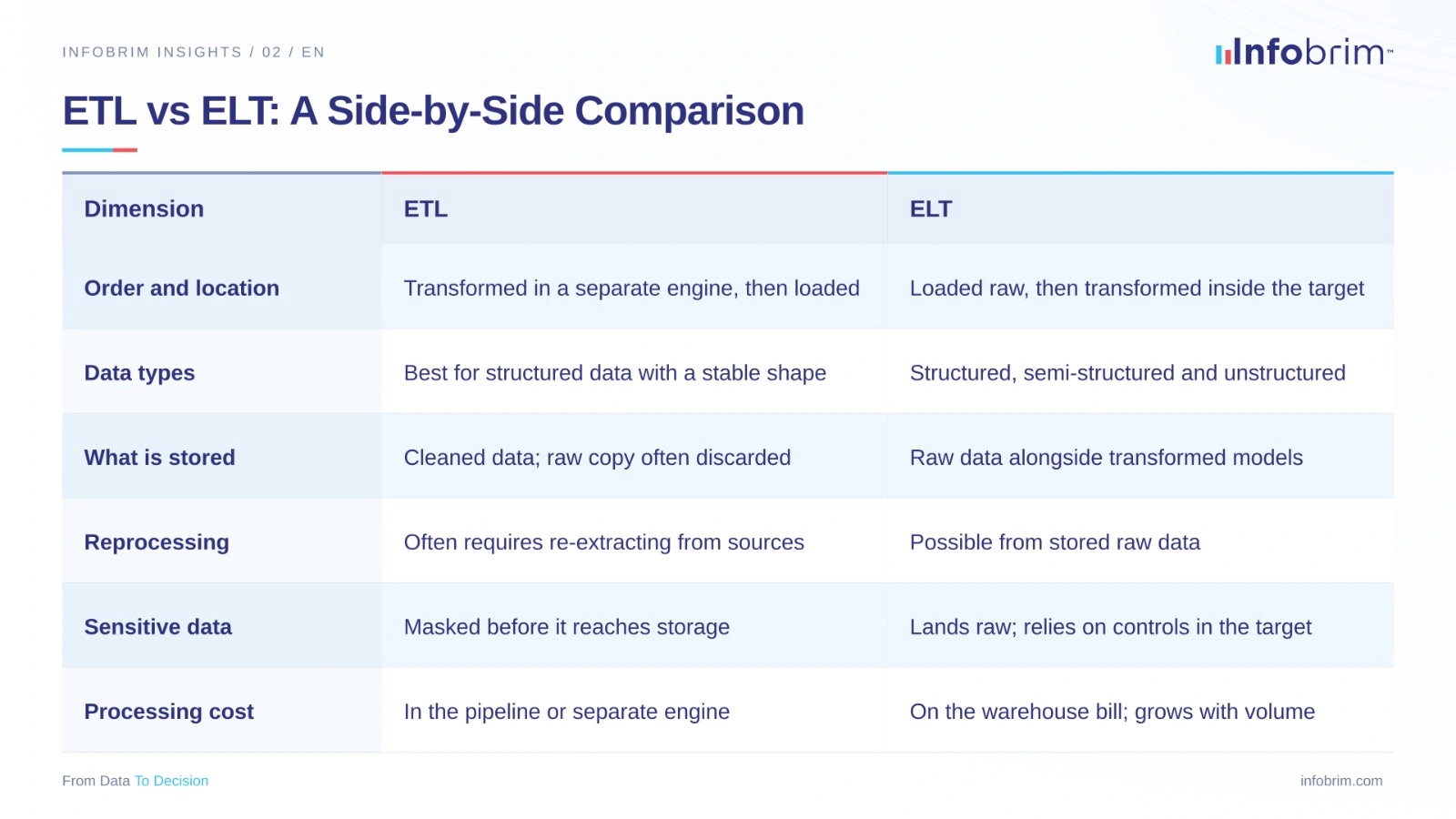
Why Do Sources Disagree on Speed, Cost and Security?
Because each answer depends on your conditions, which is why ETL vs ELT guides often contradict each other.
On speed, ELT gets data into the warehouse sooner: IBM notes that ETL load times are longer because of the transformation steps that come first.
Reaching an analysis-ready number can still take extra work in ELT.
On cost, ELT lowers the upfront spend and moves processing onto the warehouse bill. Even AWS, which calls ELT the standard choice for modern analytics, qualifies its savings as depending on the infrastructure used.
On security, it comes down to where sensitive fields are masked.
When to Use ETL vs ELT?
There is no single winner in the ETL vs ELT debate; the choice depends on your data and priorities.
When Is ETL the Better Fit?
Sensitive data: ID numbers, card numbers or balances must be masked before reaching any warehouse.
Legacy systems: IBM notes that legacy migrations often need ETL to convert data for the new target.
Stable, complex rules: transformations rarely change.
When Is ELT the Better Fit?
Large and varied volumes: big datasets are heading for a cloud warehouse.
Frequently changing sources: loading should not stop with every schema change.
Reprocessing history: say your company changes how it calculates net profit and wants it applied to the last three years. With ELT, the raw data is still there, so you rerun the transformation. With ETL, you may have to extract old data again, if the sources still hold it.
Can You Combine ETL and ELT?
Yes, and most organizations already do. Reis and Housley argue that the ETL vs ELT choice belongs at the micro level, pipeline by pipeline, rather than as one standard for the whole organization.
A common hybrid is ETLT: mask sensitive fields and do light cleanup in transit, then run the heavy modeling inside the warehouse. With change data capture (CDC), either pattern can also handle continuously arriving data.
ELT has one known risk. The same book quotes data warehousing pioneer Bill Inmon on raw data loaded for later transformation: "Six months later, that data [has] never been touched." ELT needs a clear plan for what will be used, and who owns it.
What Does the ETL vs ELT Choice Mean for Saudi Enterprises?
A typical Saudi enterprise runs SAP or Oracle at head office, separate branch systems, and data that must stay in the Kingdom. Deciding where raw data lands is as much a governance decision as a technical one.
Masking sensitive fields before storage makes existing obligations easier to manage, including the Personal Data Protection Law (PDPL), National Data Management Office (NDMO) requirements and the National Cybersecurity Authority Essential Cybersecurity Controls (NCA ECC). Confirm your specific obligations with your compliance or legal team.
Maintenance cost matters either way: 67% of highly centralized enterprises spend more than 80% of their data-engineering resources maintaining pipelines (Fivetran, May 2025).
If your real goal is to analyze data without moving it at all, read our guide to No-ETL Data Federation.
How Do You Decide Between ETL vs ELT?
Answer six questions to settle ETL vs ELT for each pipeline:
Sensitive fields: must they be masked before they reach the target? If yes, ETL or a hybrid fits best.
Volume and variety: large, varied data leans toward ELT; smaller, well-defined data suits ETL.
Source change: the more often schemas change, the more ELT helps.
Cost location: ETL keeps processing cost in the pipeline; ELT moves it to the warehouse bill.
Destination: a modern cloud warehouse suits ELT; an on-premises target often requires ETL.
Team skills: strong SQL and modeling skills favor ELT; pipeline engineering experience favors ETL.
If answers point both ways, a hybrid is usually right.
What Should You Do Next?
Choose between ETL and ELT for each pipeline, not for the whole organization.
Decide first where sensitive data must be masked.
Read our guide to Real-Time Analytics.
Learn how Decision Intelligence differs from traditional reporting.
To see how Infobrim analyzes data where it already lives, Request a Free Demo.