Your most sensitive data sits on servers you control: the ERP, finance databases, branch systems. Keeping it in-house was a deliberate choice. Yet every time someone needs an answer, that data is copied into another store, through another pipeline, onto another system that must be secured.
So the data you kept close for control ends up in more places than before.
This guide explains what analytics on your own servers involves, how it compares with the cloud, and how querying data where it lives changes the trade-off. On prem, on premises and on-premise BI all mean the same thing.
What Is On-Prem Analytics?
On-prem analytics means analyzing data on infrastructure the organization owns and controls, inside its own data centers, rather than on a cloud provider's servers.
As Joe Reis and Matt Housley put it in Fundamentals of Data Engineering, self-managed systems are still the default for established companies, which own their hardware and are responsible for running it.
Why Do Organizations Still Choose On-Prem?
The reasons are practical: control over where data sits, regulated data, legacy systems that cannot move, and existing investments. IBM notes that self-managed deployments give the most visibility into data location and movement. Reis and Housley also list industry regulations that require certain data to stay in your own data centers as a valid reason to keep workloads in-house or go hybrid.
Does On-Prem Automatically Mean Secure?
No. Owning the infrastructure gives you control, and control comes with work. IBM describes this model as offering the highest level of control and requiring the highest level of upkeep. Patching, hardware cycles, access policies, and monitoring are all yours.
How Does On-Prem Compare With Cloud Analytics?
According to AWS, the core difference is where the infrastructure sits and who manages it. Here is how on-premise vs cloud analytics usually compares:
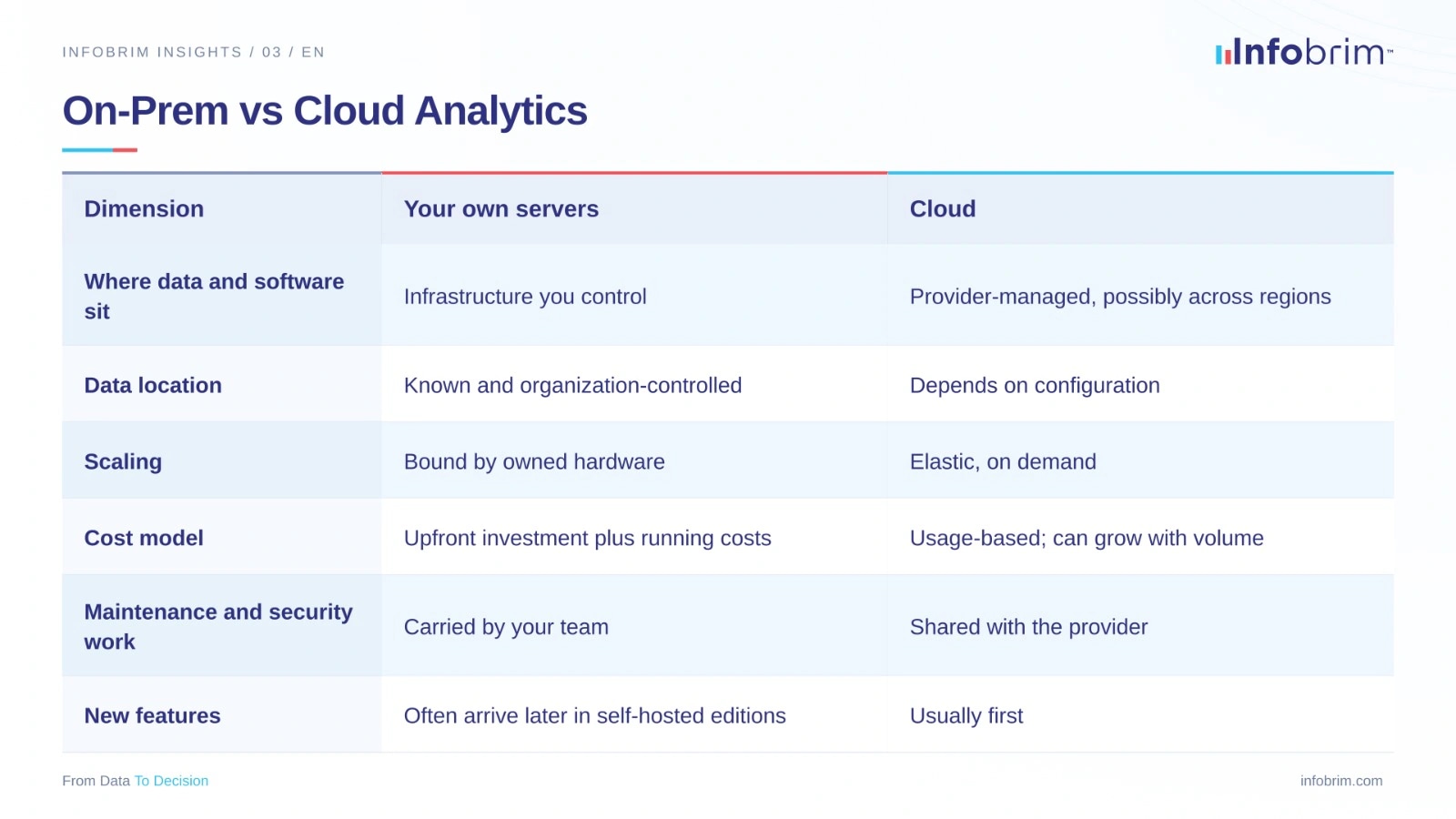
The choice is rarely all or nothing. Teradata observes that many organizations end up needing both. Reis and Housley add a warning for the other direction: moving data into a cloud is cheap, but getting it out can be expensive, which they call data gravity.
Why Does On-Prem Data Still Get Moved?
Keeping systems in-house settles where they run. It does not settle whether data gets copied before analysis, and in most organizations it does.
Data movement means copying data from the systems where it is created into another system, through migration, replication, or ETL and ELT pipelines.
Martin Kleppmann explains why in Designing Data-Intensive Applications: operational databases are critical to the business, so their administrators are reluctant to let analysts run heavy queries that could slow live transactions. The classic answer is a data warehouse holding a read-only copy of operational data.
That works, but every copy adds a pipeline to maintain and another place to secure. 67% of highly centralized enterprises spend more than 80% of their data-engineering resources maintaining pipelines (Fivetran, May 2025).
Our guide to ETL vs ELT covers the two main ways that copy is built.
What Is On-Prem Querying?
On-Prem querying is Infobrim's approach to analyzing data in your own environment: the query runs where the data already lives, so the full dataset is not transferred to another system.
It applies an idea Kleppmann describes as "putting the computation near the data": send the work to the data instead of moving the data to the work.
How Does a Query Run Where the Data Lives?
A federated query splits one question into parts, sends each part to the system that holds the relevant data, and combines the results. Query pushdown makes this efficient. In Reis and Housley's words, it "aims to move as much work as possible to the source databases", such as filtering, so far less data crosses the network.
The answer travels; the dataset stays. Infobrim is designed to apply the same governed definitions and role-based access whether a question comes from a dashboard or a natural-language prompt.
How Does It Relate to Data Federation and Virtualization?
They are close relatives. Data virtualization presents many sources as one view without storing the data, and data federation is the technique that queries them together. If you want the full picture, read our guide to no-ETL data federation.
What Are the Limits of Querying Data in Place?
Querying data in place is powerful, and it has real limits:
Load on live systems. Reis and Housley warn that a query engine which stores nothing must read from the source every time.
They cite an analyst whose single unrestricted query on a production database took down a grocery chain's inventory system for three days. Load needs controls: scheduling, limits on concurrent queries, read replicas or selective caching.
Network and availability. If a source is slow or offline, so is the answer.
Cross-system joins. Joining large tables across systems costs more than joining them inside one warehouse.
Reads, not writes. Kleppmann notes that federation unifies reading across systems but does not solve keeping writes in sync.
Heavy history. Years of reshaped history may still belong in a warehouse.
When Should You Choose On-Prem, Cloud or Both?
Querying in place: sensitive data your policy keeps in its own environment, a live view across several operational systems, or legacy systems that cannot be migrated.
Cloud: elastic, large-scale workloads on less sensitive data.
Warehouse or lakehouse: long history and heavy aggregation.
Hybrid: different needs for different datasets, which describes most enterprises.
What Should You Ask Any Vendor Offering On-Premise BI?
Where exactly does the query execute?
What data leaves the source system, if any?
How is access enforced across dashboards and natural-language questions?
What load does it place on source systems, and how is that controlled?
Which sources are supported out of the box, and how are others added?
What Does On-Prem Analytics Mean for Saudi Enterprises?
Saudi estates typically mix SAP or Oracle ERPs, databases, cloud services and branch systems, with data that must stay in the Kingdom. Fewer copies in fewer places make existing obligations easier to manage, including the Personal Data Protection Law (PDPL), National Data Management Office (NDMO) requirements and the National Cybersecurity Authority Essential Cybersecurity Controls (NCA ECC). Confirm your specific obligations with your compliance or legal team.
What Are the Key Takeaways?
An on-prem setup decides where systems run. Whether data gets copied is a separate choice.
Querying data in place sends the work to the data and returns only the answer.
It needs load management, and heavy history may still belong in a warehouse.
Most enterprises will run a hybrid of local systems, cloud and warehouse.
Explore our guides to Real-Time Analytics, Decision Intelligence, and Why 2027 Belongs To Data Platforms.
Request a free demo to see On-Prem Querying on your own systems.